
The TwoSix team is back and ready to share what’s On Our Radar for July so that you can stay ahead of the always-evolving digital marketing landscape. This month, the TwoSix team discusses ChatGPT ads, custom feeds on YouTube, AI and SEO in the email inbox, and more! Keep reading to find out what we’re keeping On Our Radar for July 2026.
 Brian Matson Senior Director of Strategy & Education
 Captions Change on Instagram Carousel Posts
This is some big news! It’s something I have been wanting for a long time. Instagram is finally making it possible to create unique captions for each element in a carousel-style post. With the change, we’re no longer stuck with having to make a single caption make sense for an entire series of content. This change opens the door for telling more compelling stories, taking viewers on a journey through those stories, and providing a bit of relief when it comes to customizing slides in the carousel to convey important information.
You should already have access to this new feature. Just look for a dropdown menu on the final page before posting. You will be able to choose a single caption for all or make individual captions for each slide.
The applications for this new feature are endless. Not only can we provide more context in our carousel posts, but we can also start to lean on some of the assets in our content war chest. Think about leveraging blog content to support image slide shows. Maybe laying out a fancy itinerary. Perhaps a “must-do” list or a listicle of historical places with reasons why they’re significant or relevant.
I highly encourage you to start using this new feature. Not only will it allows us to tell better stories, but it’s also never a bad idea to use a new feature when it is released. You’ll typically be rewarded in reach when you do so.
Have fun writing more captions!
 Nick Danowski Lead Content Strategist & Senior Data Analyst
ChatGPT Ads Are Getting a Visual Upgrade
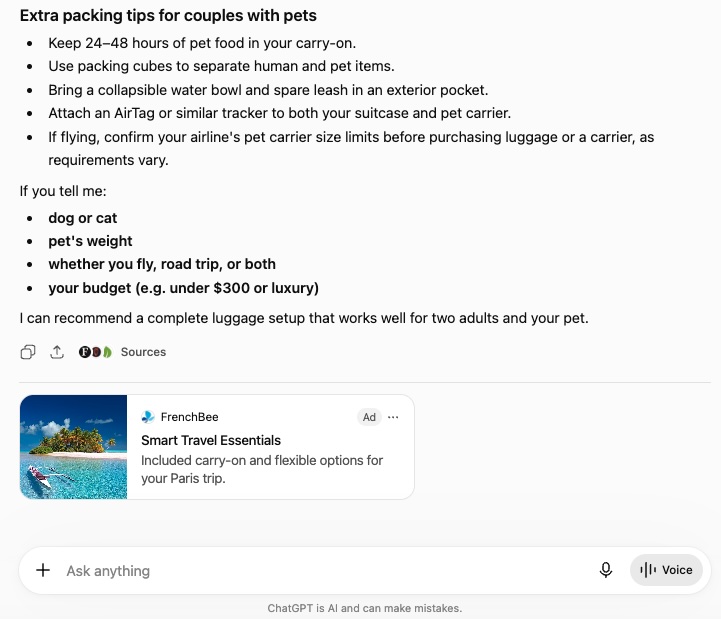
Currently, ChatGPT ads are limited to square 256×256 pictures, with a headline and body.
Since ChatGPT ads launched in February 2026, they’ve been pretty restricted in terms of creative — a small square image, along with a short headline and short body. Now, they’re beginning an “early test” of new ads with dynamic Call-to-Actions, such as “book now” and “sign up”. Portrait and landscape images are already available for some eCommerce ads.
However, more interestingly for the future, there are three new roles on OpenAI’s career page, specifically for Ad Formats. The senior role states the role as “defining how ads are structured, rendered, and delivered” with “new ad formats, including text, image, video, native, conversational, and interactive experiences”. So, we should see video and even conversational ads coming down the line. Something to definitely keep your eye on.
TwoSix Digital can now run ads on ChatGPT, and I’m personally intrigued to see how any future updates will roll out and work. Currently, ads are selected based on context, and it’s strongly recommended that each aspect of the ad should all clearly connect to users’ prompts. If there are video or interactive ads, I wonder if that may change down the line. We shall see!
 Ashley Maddix Digital Advertising Strategist
Meta and AI Generated Ads
Meta has upgraded its AI image generator to develop better looking Facebook and Instagram ads, it’s using something Meta is calling its Muse Image AI model which is supposed to understand detailed creative instructions. This can help create multiple versions of an ad, make images look more realistic and turn videos into images. So far, for travel related ads, Meta’s AI image generator has created some noteworthy images, a couple skiing on a beach, human limbs bending in ways that would send them to a hospital and so on. We’ve steered clear of using these images because they just aren’t realistic enough and for travel related ads, I believe that is still the case. Image generation for products seems to be getting better but there’s still much to be desired when there are a lot of elements in the photo and humans are involved. For example, below is an older photo I am using in a history related ad for a ski resort.

Using this photo in Meta’s image generator, these are some of the options it gave me. While the animated one is kind of cool and could be refined, the others just aren’t realistic enough.

It is also worth noting that Meta has updated its disclosure tags for ads made with AI tools. This is to increase transparency and help flag misleading ads. The AI info label will be applied when the ad features background generation, image generation or add animation. It will also be able to detect ads created using third-party generative AI tools.
It’s been a few years now since AI images have begun being integrated into social media and sometimes, they are super convincing but for the most part sticking with traditional images is the way to go. This gives more credibility to your destination because if a potential tourist sees one of these AI generated photos with the AI info label, they’re not going to believe what they’re seeing and scroll right by your destination. Maybe it’ll get there in the future but for now authentic photo and video assets are still critical.
 Makenna Schmitz Director of Social & Email Marketing


AI Inboxes Are Here... Now What?
AI inboxes are here, and they’re changing the way people interact with email. With tools like Google Gemini and Apple Intelligence bringing AI-generated summaries, priority messages, and AI-powered inbox search into the mix, your subscribers may not experience your emails the same way they used to.
But don’t panic… email marketing isn’t dying. It’s evolving. The brands and destinations that win in the smart inbox era will be the ones creating emails that are highly relevant, easy to summarize, easy to search, and valuable from the very first sentence. That means clear subject lines, front-loaded messaging, concise content blocks, searchable keywords, clean HTML text, and a healthy, engaged list.
In our latest blog, we’re breaking down what AI inboxes mean for your email marketing and how to optimize your strategy before lazy sends get left behind. Click below to read the full blog and learn how to make your emails smarter, stronger, and easier for AI to understand.
 Emma Herrle Digital Marketing Strategist
 Your Inbox is an SEO Channel
SEO and email are quietly becoming best buds. Teammates, even. New research suggests your email inbox may carry more AI search weight than ever before.
iPullRank tested Google’s Personal Intelligence feature by seeding brand mentions into Gmail and Google Photos across connected accounts. Then, they measured how often those brands appeared in AI Mode responses. Across 1,922 AI Mode responses, brand appearances jumped from 23.9% to 66.8% once Personal Intelligence content entered the case, as shown in the time series chart below.
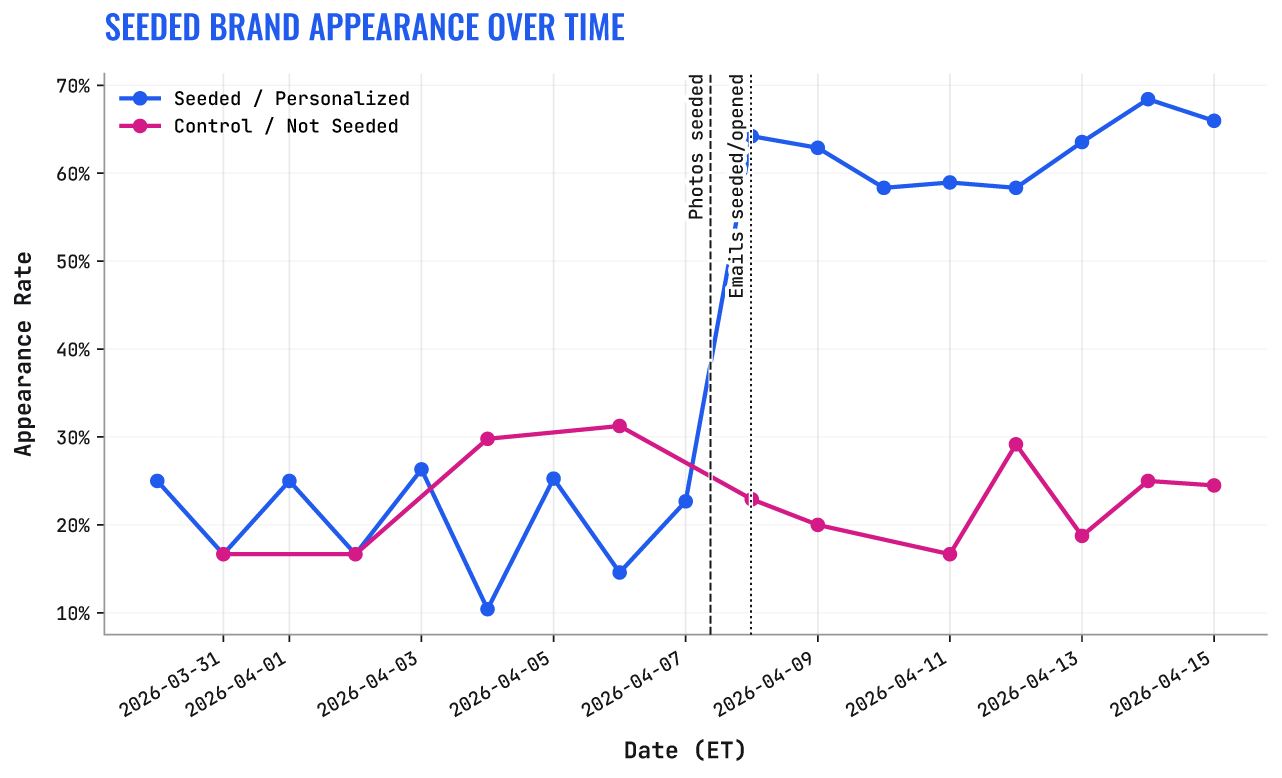
Email did the heavy lifting. Brands mentioned through Gmail appeared in 53.6% of relevant responses, compared to just 10.5% for brands introduced via Photos. iPullRank Google Personal Intelligence Experiment
So, what should this mean for your email program? Personal Intelligence is still opt-in and isn’t enabled by default. It isn’t mainstream just yet, but the idea is worth building toward now. Every email touchpoint is a potential signal. Think about your newsletters, order confirmations, event announcements and confirmations, etc.
Write these with the same clarity and specificity you’d want an AI system to extract and reuse. Think clear titles, concrete details, and language that answers real questions about your destination.
 Sydney Van Hulle Digital Advertising Strategist
Custom Feeds on YouTube
Your YouTube homepage is about to get even more customized with the latest integration of a new “Your custom feed” option.
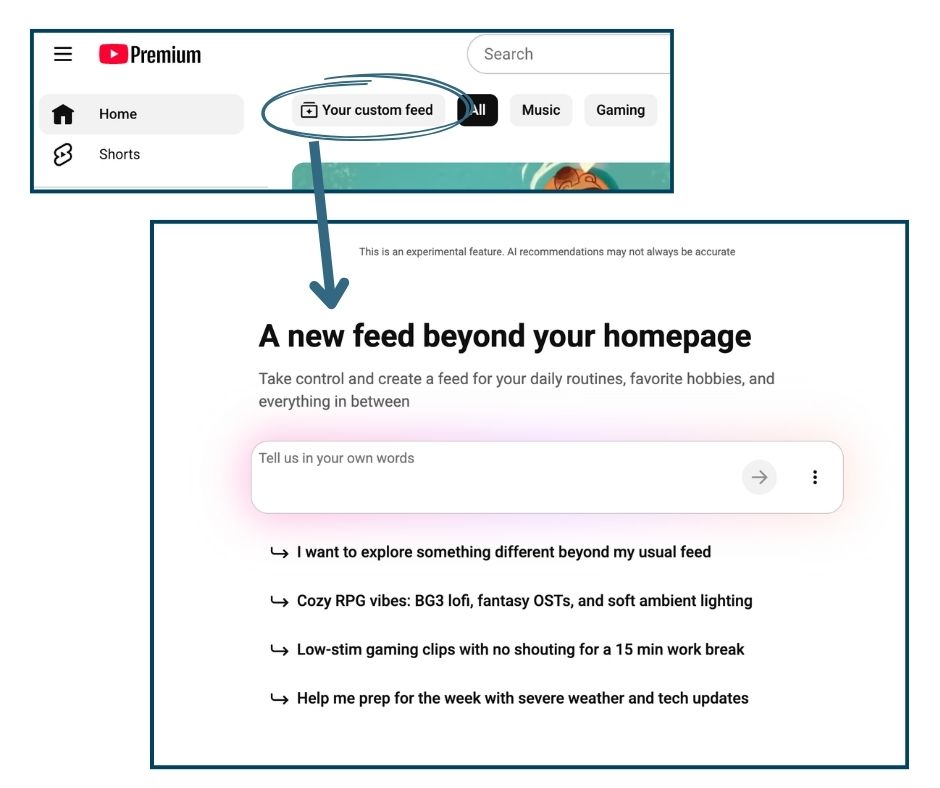
The new discovery tool mirrors Gemini (which tracks since YouTube is owned by Google) and lets you provide custom prompts based on keywords, content, and topics you are wanting to watch. YouTube will then create a new, constantly refreshing feed based on those prompts, so giving more descriptive and conversational prompts is recommended for the best user experience.
Users can view the feed at any time—found at the top homepage—and can also be tweaked at any time in the search box at the top of the feed.
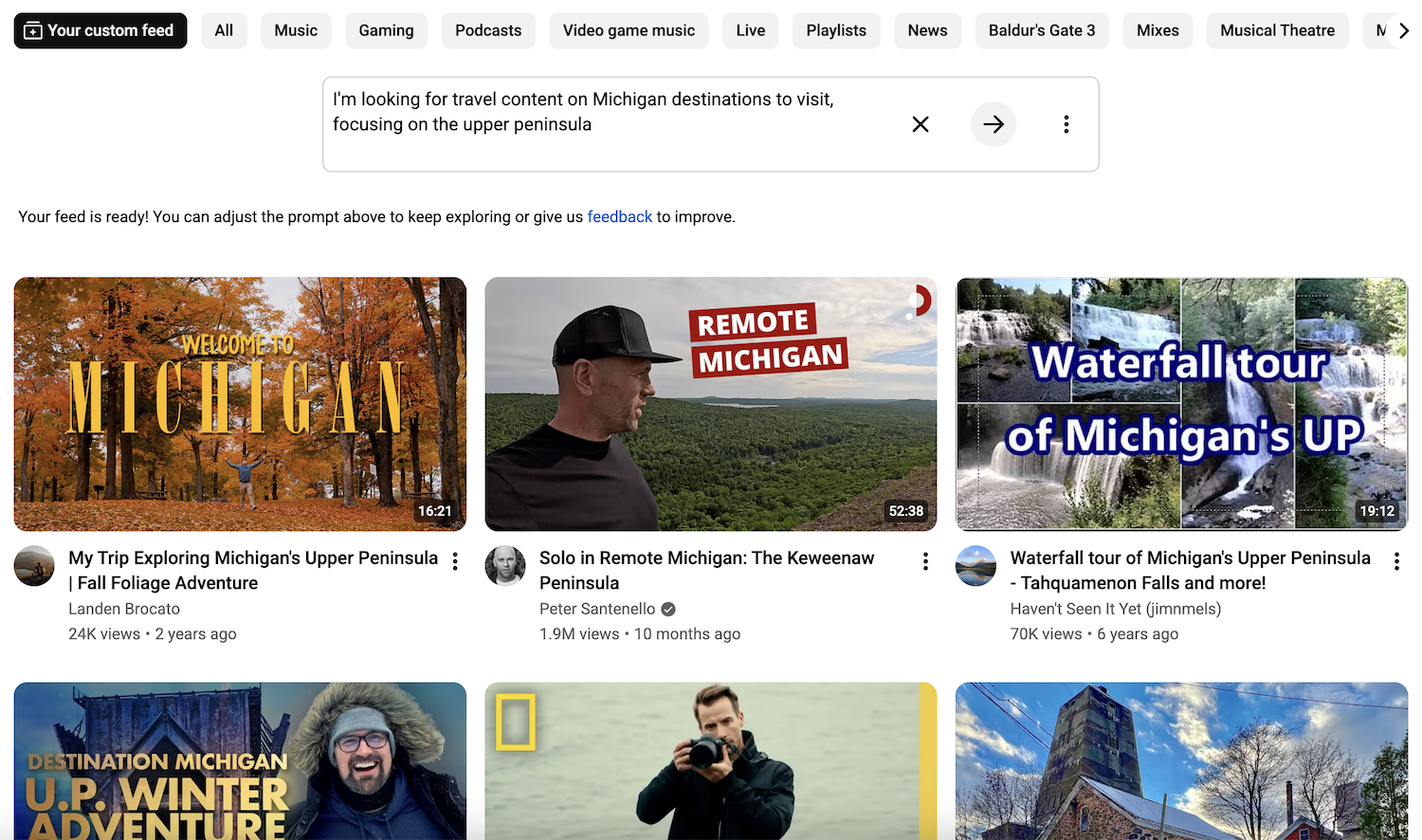
The custom feed is still in its experimental phase, but it started rolling out at the end of May, specifically to signed-in viewers in the U.S. on the YouTube mobile app or desktop in English. Users also need to have YouTube search and watch history turned on for it to work properly.
YouTube’s algorithms already do a decent job of tailoring and sharing content you may be interested in based on prior watch history. It will be interesting to see why this new custom feed option is particularly useful and how it differs from the average YouTube search and viewing experience. Open the app and test it out yourself
With the ever-changing digital marketing world, we are here to keep you informed of new digital trends and what we are keeping on our radar each month. Have any questions? Contact us! We’re here to help. Be sure to subscribe to our newsletter to receive monthly updates on trends and insights in the digital marketing and tourism industries straight to your inbox! Click the buttons below to connect with us on social media and stay in the loop on all things TwoSix Digital.