

The TwoSix team is back and ready to share what’s On Our Radar for February so that you can stay ahead of the always-evolving digital marketing landscape. This month, the TwoSix team discusses social media benchmarks, why your open rates are dropping, a new Meta app, Google’s Personal Intelligence impact on travel planning, and more! Keep reading to find out what we’re keeping On Our Radar for February 2026.
 Dave Serino Founder & Chief Strategist
 The Social-to-Search Halo Effect
A recent Search Engine Land piece highlights something that should catch the eye of all tourism marketers: great social content doesn’t just get likes — it gets people to actively search for your brand or destination online. When a Reel goes viral or a post really connects, people often don’t click through right away — they remember it and later type your name or destination into a search engine to learn more. That curiosity drives a branded search query and creates the social-to-search halo effect.
For DMOs and tourism-related establishments, this means social platforms aren’t just engagement channels — they’re also discovery engines. Even if someone doesn’t immediately book a trip after seeing a TikTok or Shorts video or social post, that content can prompt intentional search behavior that leads to deeper exploration, website visits, and eventual bookings.
This is a great of example of why your organic social content should always be aligned with your product vertical and search engine strategy. It is a clear path to more meaningful conversions.
 Brian Matson Senior Director of Strategy & Education
 Benchmarks? We Don’t Need No Stinking Benchmarks.
Actually, benchmarks are pretty nice to have, and we have some great new ones for organic social media to help guide our 2026 efforts. Social Insider recently dropped their 2026 Social Media Benchmarks report! There are some great insights in the report that will probably make some of you feel a lot better about some of the trends that you may be seeing.
For starters, it’s not just you. It’s not completely your fault if you continue to see engagement on Facebook falling off. It’s happening to everyone. Facebook currently averages just a 0.15% engagement rate on organic posts, and that continues to be steadily declining. It’s becoming pretty clear that your best bet on Facebook is a dedicated paid strategy if you want to move the needle.
The biggest gains in overall engagement on major social media channels were seen by TikTok. Engagement was up almost 50%. We’ll have to see how this changes with “new ownership”, but TikTok, from an organic sense, seems to be a pretty fruitful place to apply some organic effort. This is especially true when it comes to Instagram being almost flatlined year-over-year.
Engagement, in the form of comments, on the other hand, is declining across the board as online users appear to be “keeping it to themselves” a bit more these days. Both Instagram and TikTok are seeing double-digit percentage declines in the number of comments per organic post.
Social Insider offers up a nice overview of the current benchmarks when it comes to engagement rate:
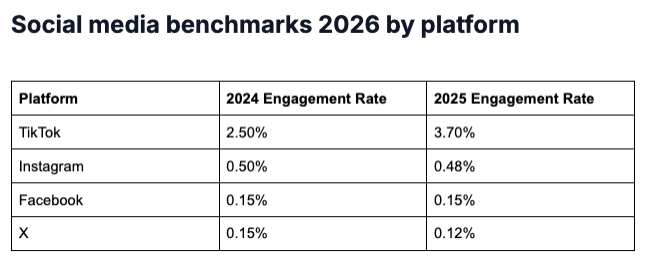
It’s important to note that engagement rate per post is calculated as the sum of reactions, comments, and shares on the post divided by the total number of fans that a page has. The result is then multiplied by 100. Personally, I am not a particular fan of this way of calculating engagement per post, but we have to follow the leader on this one in order to have a true apples-to-apples comparison. I’d love to see numbers produced from dividing the number of views a post had instead. To me, that would tell a much more accurate story of how a particular piece of content is performing. It’s always up for debate, though!
With that said, I think the report is useful to identify some trends as we move along into 2026. It’s definitely worth the free download and a few minutes of your time. Even if you simply use it to say “hey, it’s not just me”.
 Nick Danowski Lead Content Strategist & Senior Data Analyst
 Google Search Isn’t Being Replaced by AI… Yet
In the past year or two, some of us have seen fewer and fewer website sessions, especially from Google Search — which has historically been a stalwart driver of traffic to our sites. Of course, this is primarily due to the prevalence of generative AI chatbots, along with Google’s AI Overviews. Recent data estimates that ChatGPT now has about 17% of digital query market share, compared to Google Search’s 78%. ChatGPT’s share is also on the rise, growing from 10% at the beginning of the 2025 to that 17% figure.
However, I believe this stat is misleading. The most important thing to remember is that, typically, you’re chatting with a chatbot — there’s multiple queries being used each time — while a Google Search usually hits the market the first time. Also, ChatGPT’s share of transactional queries (those relating to purchases) began to plateau in 2025, demonstrating the Google Search is still crucial for businesses. Finally, a recent survey found that “87% of ChatGPT Pro and Plus users still prefer Google for search”. They see ChatGPT as a complement, not a replacement for Google… yet.
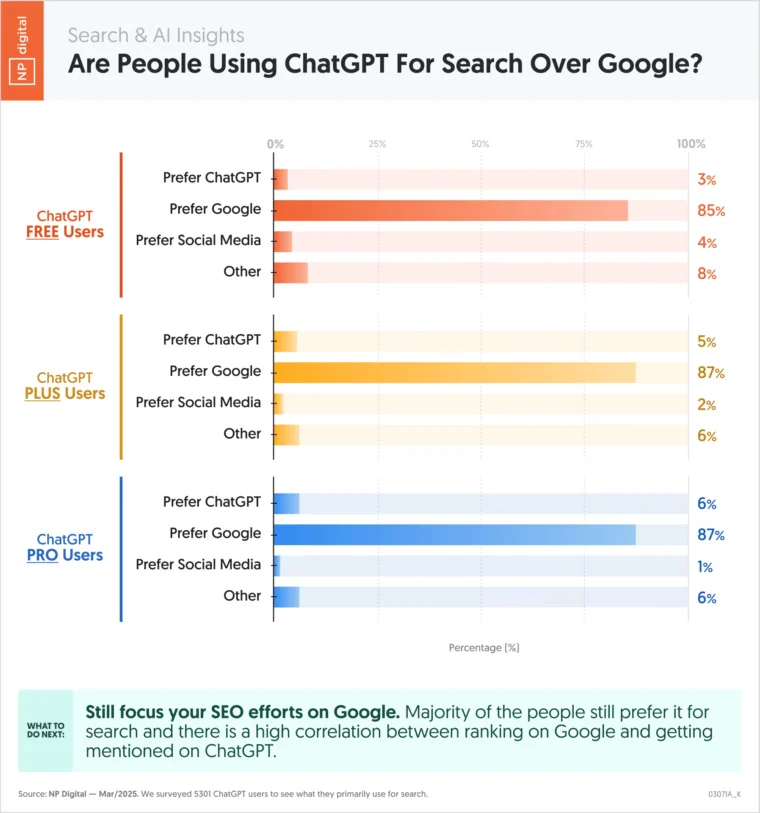
Google Search is just so convenient and fast. Plus, it doesn’t have the stigma that AI has related to water-use or the tendency to hallucinate. The main concern for digital marketers should remain Google’s AI Overviews. That’s what’s taking away our organic search traffic the most. For businesses, especially those that have purchases, probably won’t be affected too much in the near future.
For DMOs, Google’s AI Overviews are a concern. Traffic will likely remain in the red year-over-year. Look into optimizing for and tracking AI Citations, to have the year-over-year green in your reports.
 Scout Delicato Lead Digital Marketing Strategist
 A New Meta App Is Coming
Meta announced it is launching a new standalone app that is entirely based on AI-generated video. Not enhanced video. Not tools for creators. Entirely AI-generated.
From an ad perspective, this is definitely worth paying attention to. More content means more inventory. More inventory means more places to test, optimize, and eventually scale. If Meta can somehow keep people engaged with AI video the same way they are with Reels or TikTok, advertising is sure to follow.
But how is this going to play out in the travel industry? AI video is fantastic at speculating about things and producing digital artwork, but what it is not fantastic at is being credible. And credibility is still what the travel industry is all about. Consumers want to know what a destination really looks like, what the weather is like, what the food is like, what other real people experienced when they were there. A perfectly generated sunset over a coastline might get a second look. It doesn’t replace a real video from someone who was actually there.
So other industries might be all about embracing fully AI-generated creative content, but the travel industry is probably going to sit this one out, at least for now. And to be honest, this isn’t necessarily a bad thing. Social media managers in the travel industry already have the hardest part of this equation handled. The content is real. The stories are real. The destinations are real.
This is still something that is worth paying attention to. If Meta gets a real AI video platform off the ground, this is going to change how discovery happens on their platforms, including Threads. But it’s not a direct correlation across all industries. Some brands are going to kill it in a world of generated content. Destinations are still going to win by being themselves.
 Ashley Maddix Digital Advertising Strategist
 Reels is for Real
Reels is really becoming the advertising hot spot as 2025 reports have shown. Over 50% of Instagram ads ran in reels in 2025. That’s up from 35% just a year earlier. Total time spent watching Reels was up in 2025 almost 10% over the previous year. Even on Facebook, Reels accounts for 29% of time on the app. Ad formats are continuing to change within the app like skippable ads that have been popping up in Meta Reels but not so much on Instagram yet. As Reels popularity continues to grow, the app itself may change by getting an app all to itself and they have begun testing a TV app in which you could watch your Reels on your TV. This does open the opportunity up for advertisers and destinations to consider organically posting on Reels and putting a little paid effort behind them. We’ve found success boosting Reels in the past year. These often rack up great engagement numbers and have extremely respectable click through rates. Staying active where the consumer is, is key whether that’s reaching them organically or putting a little money behind it to expand your reach. If you haven’t dabbled in Reels yet, make that a 2026 marketing goal!
 Makenna Schmitz Director of Social & Email Marketing


Bot Filtering Is Changing Your Email Data (Don’t Panic)
If your open rates suddenly dropped from 35% to 10% overnight… you’re not alone.
Email platforms, including Mailchimp and Constant Contact, are rolling out enhanced bot filtering that removes “fake” opens and clicks. These bot engagements can be caused by security software, firewalls, Apple Mail Privacy Protection (MPP), and other automated systems. For years, we’ve heard that open rates are becoming less trustworthy, but now we’re seeing just how much bots have been inflating our data.
Here’s what tourism marketers need to know:
Your open rates will probably drop… a lot.
With bot filtering on, opens and clicks from security programs have been excluded from your data. Meaning, you’re likely going to see a significant decrease in open rates and potentially click rates as well. Don’t panic! This is to be expected. Instead of getting down on ourselves about the new reality of our email analytics, let’s look on the bright side! Does it really matter if we have a 40% open rate if none of these people are converting? Not really. At least now, when we see that 10-20% open rate, we know those are real people who are actually interested in seeing your content. That’s a win!
Your reports are getting cleaner, not worse.
This isn’t just an email platform issue; it’s industry-wide.
We know that Apple’s MPP, Gmail image prefetching, and corporate firewalls have been auto-opening and auto-clicking emails for years. So, depending on your audience, bot activity may have been heavily skewing your data more than others. For DMOs sending to media contacts, planners, or school systems, bots have likely been inflating your clicks for quite some time. Again, this is just something to keep in mind as you’re reviewing your new and “improved” email results.
It’s time to stop obsessing over opens, for real.
This update reinforces something we’ve been telling clients for years:
Open rate is not your success metric.
Instead, focus on things like:
- Conversions (bookings, ticket purchases, guide downloads)
- Website sessions from email
- Click-through rates
- Unsubscribes
If your winter getaway email drove hotel package bookings, that’s what matters, not how many opens you got. Focus on real conversions!
Something to look out for: A/B testing & automations may behave differently.
This is an area to watch. Bot activity being removed could potentially cause:
- Subject line tests to show different winners
- Click-based automations may trigger more accurately
- Engagement-based segments (“has opened in the last 30 days”) may shrink
Your “highly engaged” segment might suddenly look less highly engaged, but that’s okay. It’s more honest data!
The big picture:
These new systems use detection like digital fingerprinting, IP intelligence, and behavioral analysis to filter bot activity without removing real human engagement. Meaning, you can make more accurate campaign benchmarking, have clearer ROIs, and more confidence in what actually drives travel for your destination.
If your email results look worse this month, take a breath. Your audience didn’t disappear… your data just got more honest.
 Emma Herrle Digital Marketing Strategist
 Google’s Personal Intelligence Brings Change to Travel Planning
Google recently announced an expansion of its Personal Intelligence capabilities, bringing them directly into AI Mode in Google Search alongside their existing rollout in Gemini. This update allows users (just Google AI Pro and Ultra subscribers for now) to opt-in to connect their Google app data, like Gmail and Google Photos, so that search can deliver answers and recommendations based on their specific context and history rather than just general web results.
In the travel space, this means that instead of explaining your itinerary and travel preferences in detail, Google’s AI can use context from past trips, hotel bookings from your inbox, and photos from your image library to produce highly personalized recommendations. See this example where Google sources context from connected apps, including children’s names, a spouse, their ages and appropriate activities that this family would probably enjoy during a trip (creepy!):
This is a huge shift from traditional, intent-based search and reinforces what marketers are already anticipating: a space where behavioral awareness matters more than targeting. Our content is meeting users in the middle of a task-based environment where they are typically solving a problem, making a complex decision, or in this case, planning a trip. Content will need to be genuinely helpful, hyper-specific to different demographics, and context-rich to break through.
 Sydney Van Hulle Digital Advertising Strategist
 YouTube Ads in the Age of TV
One of the most surprising metrics we encountered last year was the rise of YouTube ads being seen on TVs rather than on mobile or desktop. Users are treating YouTube less like a social platform and more like traditional television.
I personally love putting on a lengthy video essay while eating dinner.
Last year, Nielsen reported that out of the roughly 45% of users who watched programming on streaming services, 12.5% of that came from YouTube, ranking higher than Netflix, Prime, and other popular streaming platforms.
When an ad appears on a TV, it’s no longer competing with notifications, endless scrolls, or background noise. That means low-effort, phone-first ads can stand out for all the wrong reasons. So, when it comes to creating video content and running YouTube ads, keep the following best practices in mind:
- Strong branding in the first few seconds
- Clear visuals that work on large screens
- Simple messaging that’s easy to follow from the couch
- Quality audio and pacing